4-Week At-Home Workout Plan: Minimal Equipment Daily Guide
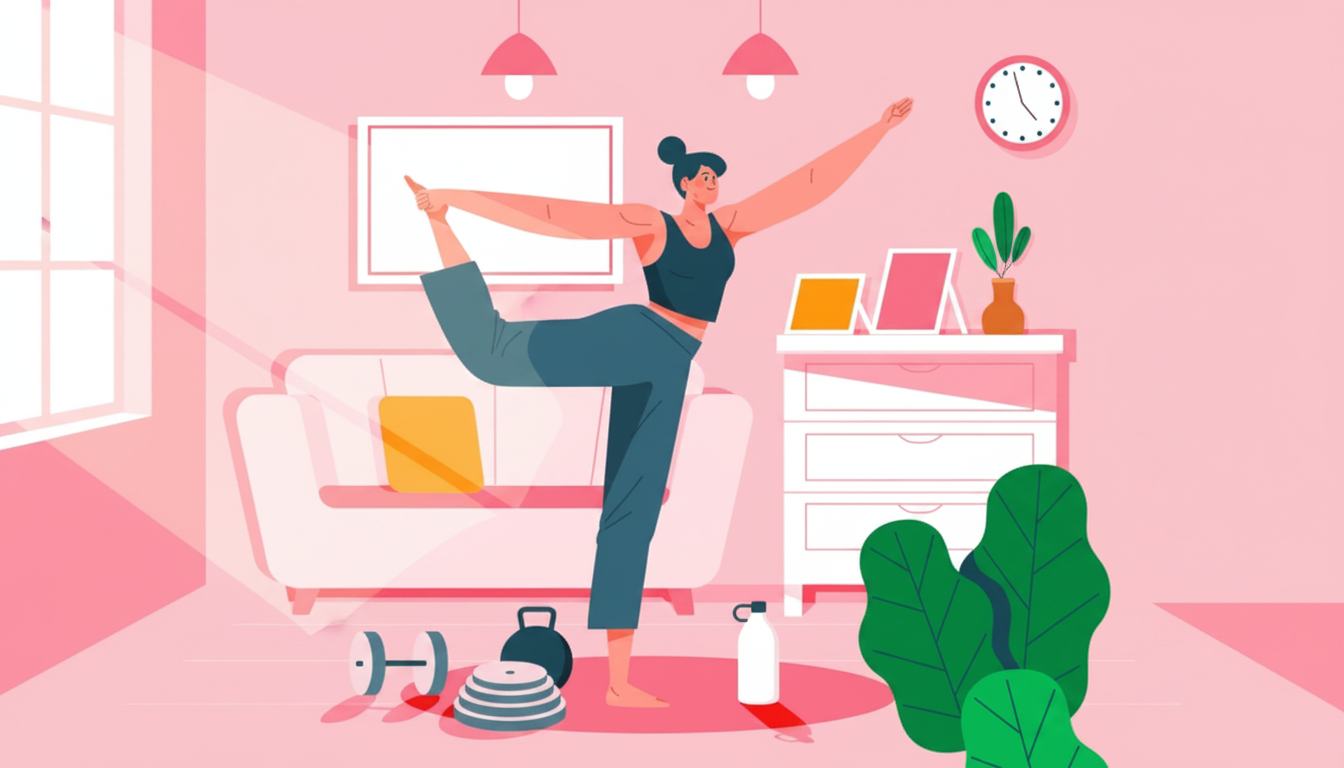
Fit at Home: A 4-Week Minimal-Equipment Workout Plan with Daily Workouts and Stretches
A structured month-long routine can make home training feel simpler: show up, follow a clear daily plan, and track progress without needing a full gym. Below is a practical 4-week schedule concept, guidance on minimal equipment, pacing, and recovery, plus an optional printable-style format for staying consistent.
What a 4-week home plan includes (and why it works)
A solid home plan removes the daily “what should I do?” question by repeating a simple structure: warm-up, main workout, and cooldown stretches. That small bit of predictability reduces decision fatigue and makes it easier to string together consistent weeks.
- Daily structure: warm-up, main workout, and cool-down stretches to support recovery.
- Balanced training: strength, conditioning, core, mobility, and true rest days.
- Progression over 4 weeks: increase reps, slow the tempo, shorten rest, or add light resistance.
- Short sessions: enough to fit a busy schedule while still building momentum.
For general health targets and weekly activity guidelines, see the CDC Physical Activity Basics and the World Health Organization physical activity fact sheet.
Minimal equipment setup for effective workouts
You can get a lot done with bodyweight alone, but a few simple items make progression easier and workouts more comfortable—especially for pulling movements (rows) and glute/hip work.
- No-equipment essentials: a mat or towel, a sturdy chair/bench, water bottle, and a timer.
- Helpful add-ons: resistance bands (loop + long band), light-to-moderate dumbbells, and an optional jump rope.
- Space check: enough room for a plank, a step-back lunge, and an overhead reach.
- Comfort and safety: supportive shoes for impact days; barefoot is fine only if stable and comfortable.
| Item | Best for | Swap if you don’t have it |
|---|---|---|
| Exercise mat | Floor work, core, mobility | Towel or carpeted area |
| Chair/bench | Step-ups, incline push-ups, triceps work (modified) | Sturdy couch edge or stair |
| Resistance band | Rows, glute work, presses, assistance | Backpack with books |
| Dumbbells | Progressive strength work | Water jugs or filled tote bags |
| Timer app | Intervals and rest control | Clock with a second hand |
Weekly flow: a repeatable schedule that builds momentum
A practical rhythm is 5 training days + 2 recovery days. Recovery can be a light walk and mobility work—still part of the plan, still worth checking off.
- Rotate patterns: squat/lunge, hinge, push, pull, carry/core stability.
- Keep ~48 hours between hard sessions for similar muscle groups when possible.
- Use an effort guide: finish most sets with 1–3 reps in reserve so you can train consistently.
| Day | Focus | Example components |
|---|---|---|
| Day 1 | Lower-body strength + core | Squat pattern, glutes, plank variations, stretches |
| Day 2 | Upper-body strength + posture | Push variation, row/pull (band), shoulder mobility |
| Day 3 | Conditioning (low-impact) | Intervals (marching/jump rope), light core, breathing reset |
| Day 4 | Full-body strength | Hinge pattern, push, pull, carries, cooldown |
| Day 5 | Mobility + core | Hip/shoulder mobility, anti-rotation core, longer stretches |
| Day 6 | Active recovery | Easy walk, gentle mobility, optional stretching |
| Day 7 | Rest | Full rest or short recovery routine |
How to progress from Week 1 to Week 4
Progress doesn’t require heavy weights—it requires a repeatable plan and one small “upgrade” at a time. If you’re new (or restarting), keep form clean and choose variations you can own.
- Week 1: learn form; choose starting variations you can repeat without soreness wrecking the week.
- Week 2: add a small amount of volume (1 extra set) or a few reps per set.
- Week 3: increase challenge with tempo (3 seconds down), shorter rest, or slightly harder variations.
- Week 4: keep form sharp while pushing one variable (reps, resistance, or intervals) and protect sleep and recovery.
- No-heavier-weights options: pause reps, isometric holds, unilateral work, or longer sets.
For training principles and general guidance, the American College of Sports Medicine (ACSM) resources are a helpful reference point.
Daily warm-ups and cooldown stretches that match home workouts
A short warm-up prepares joints and raises your core temperature; a short cooldown helps you shift down and keeps mobility from sliding as training volume increases.
Warm-up (5–8 minutes)
Cooldown (5–10 minutes)
| Stretch | Targets | Suggested time |
|---|---|---|
| Hip flexor lunge stretch | Hip flexors, quads | 30–60 sec/side |
| Figure-4 glute stretch | Glutes, outer hip | 30–60 sec/side |
| Doorway chest stretch | Chest, front shoulder | 30–60 sec/side |
| Hamstring stretch | Hamstrings | 30–60 sec/side |
| Child’s pose + side reach | Back, lats | 45–75 sec |
Staying consistent: tracking, timing, and recovery
Printable-style plan option: a guided PDF with daily workouts and stretches
- Fit at Home: 4-Week Workout Plan (PDF) — daily workouts and stretches designed for minimal equipment and small spaces.
- Memory Boost Worksheets for Students & Adults — a printable option for focus and recall tools that pair well with habit-building and routine planning.
- Top 50 Side Hustles That Actually Pay — a separate digital download if your goal is to stack a fitness routine alongside a structured personal project.
FAQ
How long should each daily home workout take?
Most daily sessions work well in the 20–45 minute range: about 5–8 minutes to warm up, 12–30 minutes for the main work, and 5–10 minutes for cooldown stretches. Even 15–20 minutes can be effective when it’s consistent and progressively challenging.
Can results happen with minimal equipment only?
Yes—results come from progressive overload and consistency, not from fancy gear. You can progress with more reps, slower tempo, shorter rest, unilateral variations, or adding resistance with bands or a loaded backpack, while supporting it with solid sleep and nutrition.
What if a movement hurts (like squats or push-ups)?
Distinguish effort (normal) from sharp or persistent pain (not normal). Reduce range of motion, switch to an easier variation (chair squats, incline push-ups), or slow down the tempo; if pain is sharp, worsening, or doesn’t resolve, consult a qualified clinician.










Leave a comment